Chapter 2
Why Direct Payments
Bitcoin makes more sense when you start with a question you have probably already asked: why is it so hard to just send someone the money?
You Already Know The Problem
You want to send $50 to a relative in another country. Western Union charges $12. A bank wire costs $30 and takes three days. Even Venmo only works if both people live in the same country and have accounts.
Or maybe the problem is smaller. You read a good article and would pay a dime for it, but the site wants $12 a month. A street musician posts a video you love and you would tip a dollar, but the platform takes a third of it and the rest does not arrive for weeks.
These are not edge cases. They are everyday friction that most people have learned to accept.
The internet lets you send a photo to anyone on earth in seconds, for free. Sending five dollars to the same person still requires a company in the middle, a fee, and sometimes days of waiting.
We solved this problem for information decades ago. We still have not solved it for money.
Money Solves A Coordination Problem
Stepping back: money itself is just a coordination tool.
You have fish. You need shoes. The shoemaker does not want fish. Money gives people a shared middle step so that any two people can trade, even if neither wants what the other has.
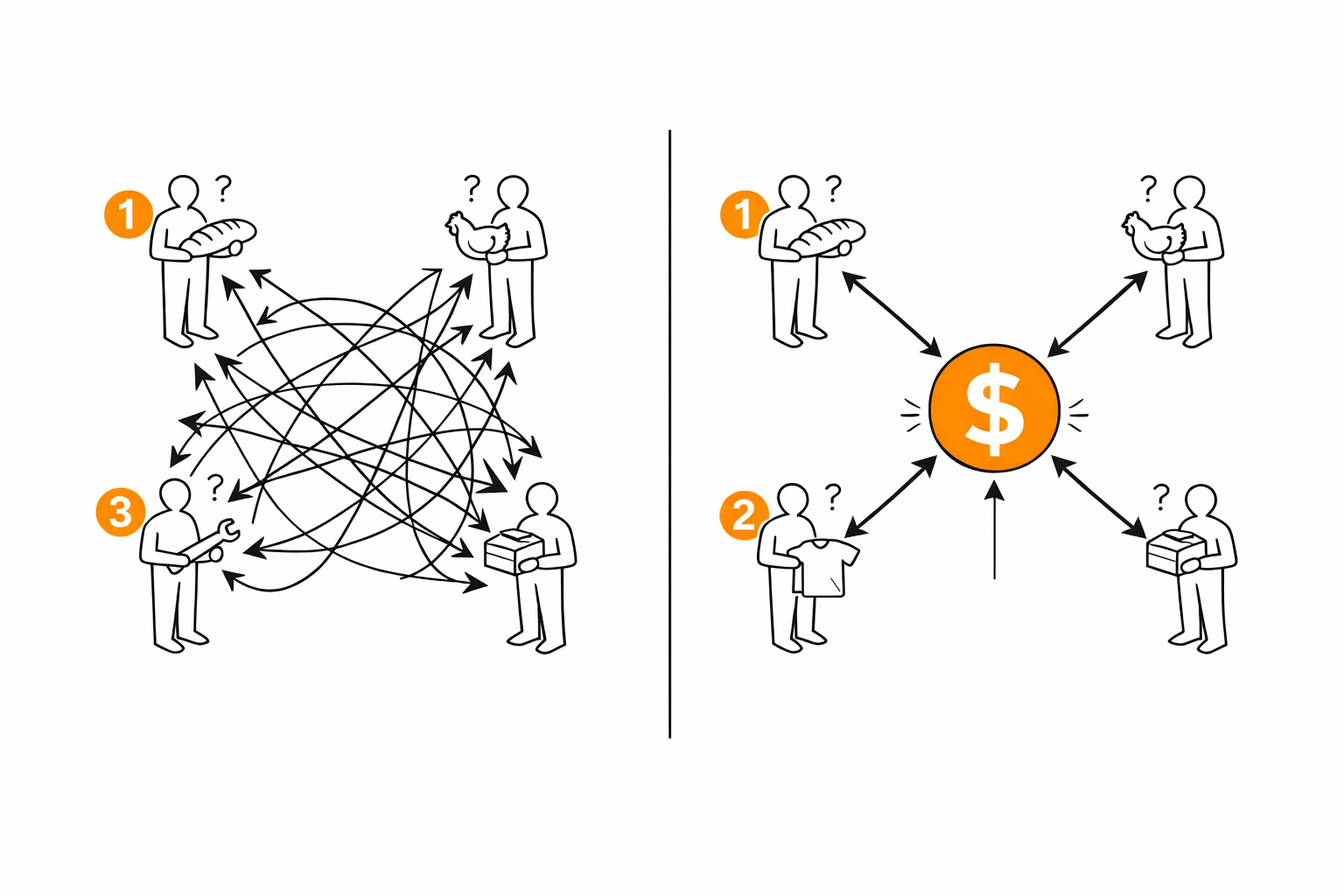
Barter is messy. Money becomes the shared hub.
Good money helps people do three ordinary things:
- It helps you trade for what you need.
- It holds value long enough to save and plan.
- It gives people a common way to quote prices.
For a beginner, the main point is simpler: money is a coordination tool. Better money reduces friction.
A Good Beginner Filter
When a payment system feels abstract, ask three plain questions:
- does it help two people exchange more directly
- does it make small payments easier or harder
- who gets to delay, reverse, or refuse the payment
Online Money Still Uses Middlemen
Most money today is not cash in your pocket. It is a record in somebody else’s database.
When you pay online, a surprising number of parties may sit between you and the person receiving the money: banks, card networks, processors, and merchants’ banks. The flow usually works, but it is not direct.
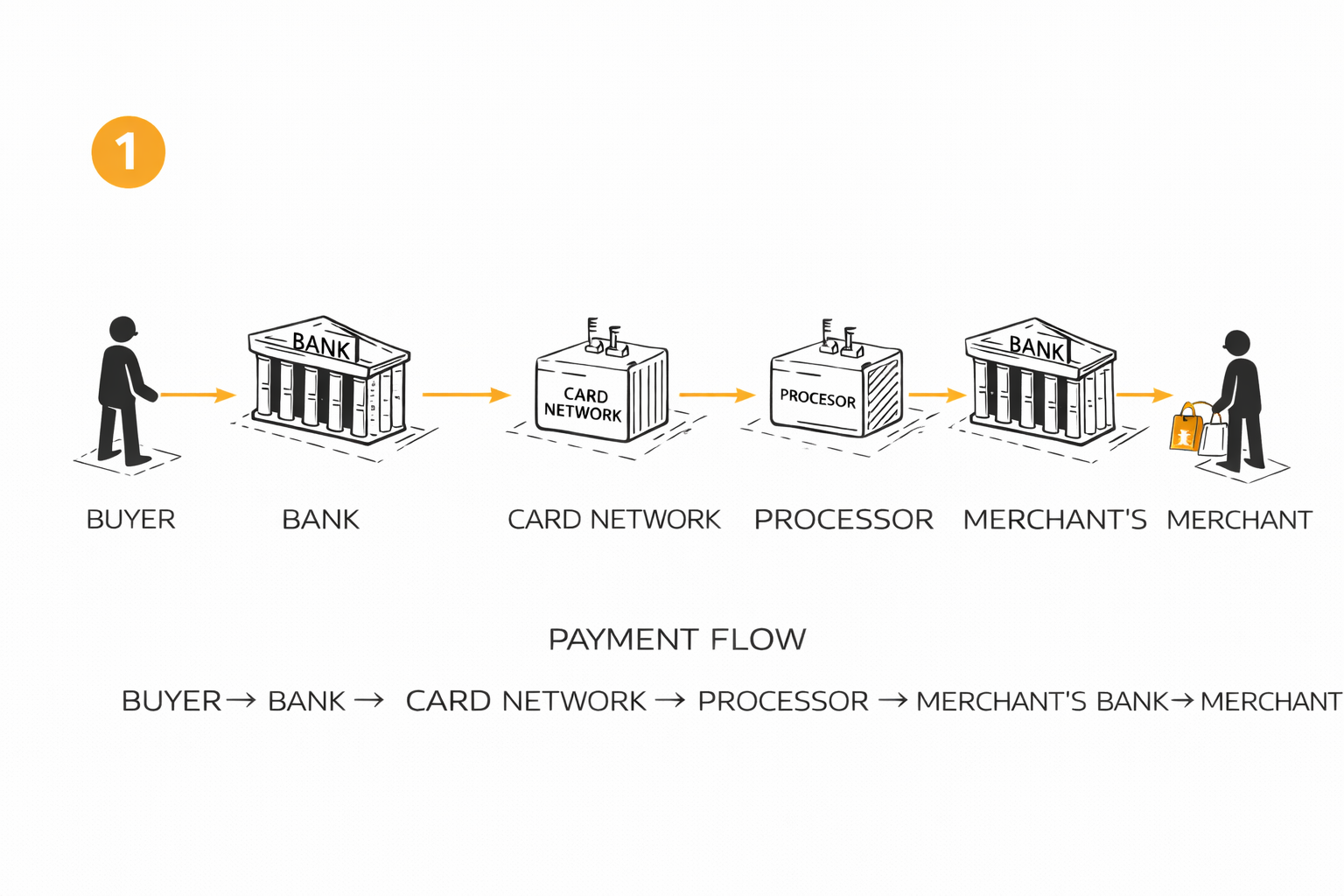
Most online payments pass through several intermediaries before they settle.
That arrangement creates trade-offs:
- payments can be reversed later
- small payments become uneconomical
- some people are excluded from the system entirely
- cross-border payments can be slow and expensive
These trade-offs were necessary when the systems were designed. Banks needed intermediaries because trust had to be established between strangers who could not verify each other directly. Card networks needed processors because merchants could not connect to every bank on their own. Each layer solved a real problem.
But the layers add up. And as information technology accelerates, the overhead of those older layers becomes a relative inefficiency—not a flaw in the original design, but a cost that no longer needs to be this high.
The internet moves information fast. Money still often moves through older rails, older business models, and other people’s permission systems.
Why Electronic Cash Matters
Cash has useful properties that many digital payments lost.
Cash is direct. Cash is final. Cash can work for small amounts. And cash does not require every payment to pass through an account relationship first.
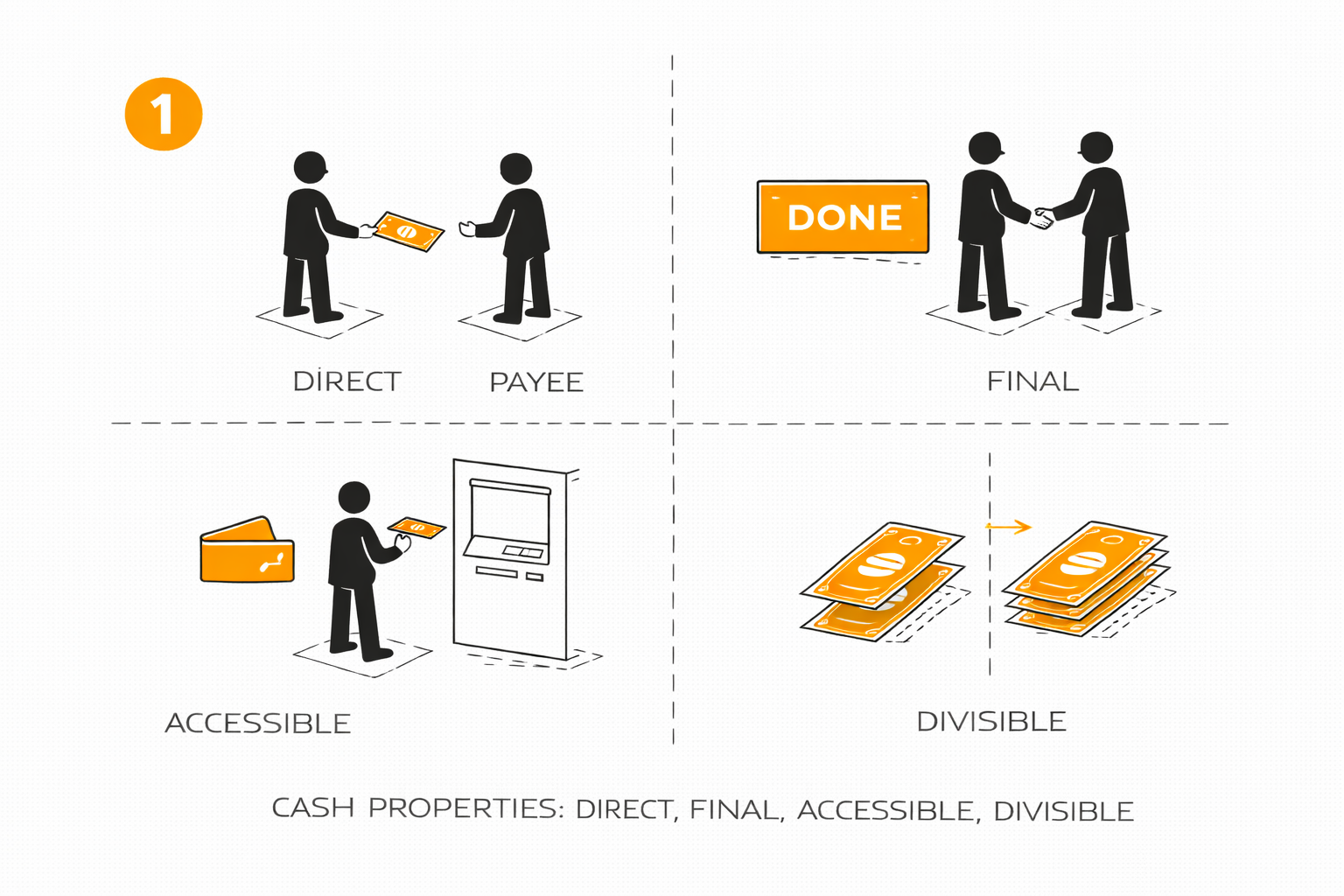
Cash is direct, final, accessible, and easy to divide into small amounts.
That is why the phrase electronic cash matters. The goal is not to replace every bank or card. The goal is to make direct digital payments possible when direct payment is the better fit.
If every digital payment requires an account relationship, a gatekeeper, and a meaningful fee, some uses of money simply never show up. The local newspaper that could charge five cents per article instead charges twelve dollars a month or runs ads. The musician who could earn a penny per play instead gets a fraction of a cent from a platform that takes the rest. The freelancer who could be paid instantly across a border instead waits a week and pays a wire fee.
These are not hypotheticals. They are business models and livelihoods that do not exist because the payment infrastructure prices them out.
Bitcoin only matters if it helps digital money feel more direct, more final, and more usable at small scale.