Chapter 8
After The First Send
If you have read this far and completed the basic flow, you do not need more hype. You need repetition.
What Good Progress Looks Like
Progress in Bitcoin is not memorizing jargon. It is making a few careful habits feel ordinary.
A useful beginner can do a handful of things calmly and reliably:
- explain what a wallet does
- protect the seed phrase
- receive and send a small amount
- stay calm while a payment is pending
- check what network a service actually supports
The real beginner advantage is not buying low. It is learning good habits while the stakes are still small.
What Good Tools Feel Like
Good tools do not try to impress you with complexity. They make the important things obvious.
Good wallet design usually does three things well:
- it makes backup hard to ignore
- it makes receive and send easy to understand
- it reveals deeper controls only when you need them
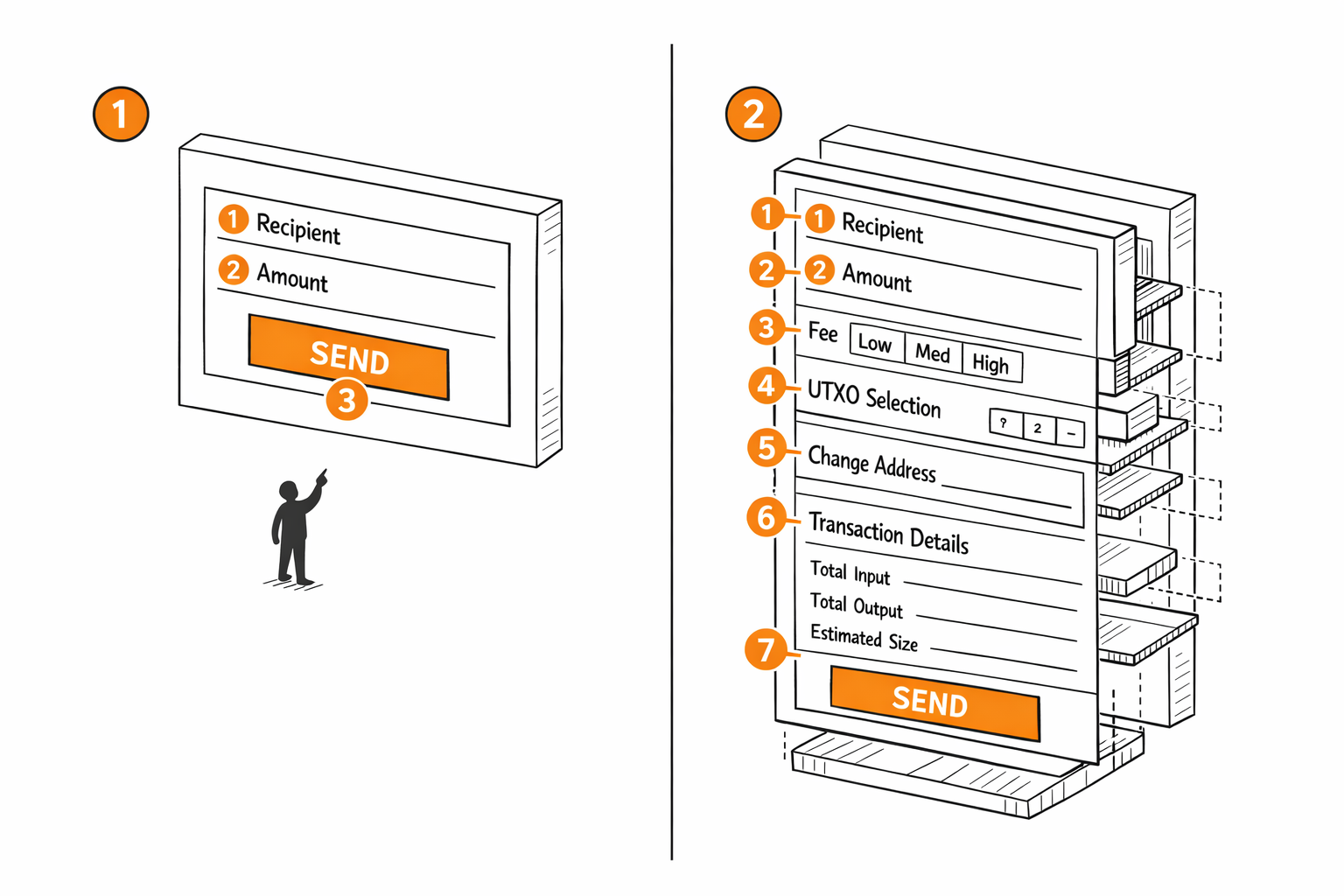
A good wallet keeps the first-use flow simple and reveals extra detail only when the user needs it.
If a wallet makes you feel lost before you even receive a small amount, switch while the amount is still trivial.
Look It Up Yourself
A block explorer is a read-only window into the network. It lets you check what the network sees instead of relying only on what the wallet UI tells you.
If your wallet gives you a transaction ID, paste it into an explorer for the same chain and look for the basic facts:
- whether the transaction exists
- whether it is pending or confirmed
- the amount that moved
- the change that came back to you
- the fee that was attached
Try It: Check Your Last Transaction
Use an explorer that matches the chain you are on.
If you are using BTC, use a BTC explorer. If you are using BCH or BSV, use an explorer for that chain.
Look up:
- the transaction ID from your wallet, or
- the receive address you used
Then answer three questions:
- did the network see the transaction
- is it still pending or already confirmed
- do the amount and destination match what you intended
What To Do This Week
Keep the next steps boring and practical:
Action Checklist
- ☐ keep only a small learning amount in the wallet
- ☐ back up the seed phrase carefully
- ☐ send one more small transaction—try adding a memo if your wallet supports it
- ☐ look up the transaction on an explorer and check whether the memo appears
- ☐ explain the wallet, seed, and transaction model to one other person without jargon
If you can explain those basics clearly, your understanding is already getting more solid.
What You Should Be Able To Say Now
If this book worked, you should now be able to say:
- I know what problem Bitcoin is trying to solve.
- I know that a wallet holds keys, not coins.
- I know why the seed phrase matters.
- I know how a first transaction feels.
- I have sent at least one transaction—ideally one with a memo attached.
- I know enough to keep learning without pretending I know everything.
A Glimpse Ahead: Payments That Carry Meaning
You just sent value. But a transaction can carry more than an amount.
Some wallets let you attach a short memo to a transaction—a note that travels with the payment and gets written into the public record. It might be a receipt reference, a thank-you, or just a label so you remember what the payment was for six months from now.
Try It: Send a Transaction With a Memo
If your wallet supports it, send a small amount to yourself or a friend and include a short message—even just “test.”
Look for:
- a “memo,” “message,” or “note” field on the send screen
- the option may appear under advanced or optional settings
After the transaction confirms, look it up on an explorer. You should see your memo stored alongside the payment.
This is a small example of a bigger idea. Bitcoin transactions are not just IOUs—they are programmable messages. The network can enforce simple rules automatically: release a payment only after a certain date, require two people to sign off, or lock funds until a condition is met.
These rules are sometimes called smart contracts, but the name makes them sound more exotic than they are. Think of them as instructions baked into the payment itself—no phone call to a bank, no manual approval step, no intermediary deciding whether to follow through.
You do not need to understand how these work under the hood right now. What matters is the user-facing implication: as wallets improve, payments will do more than move money. They will carry context, enforce agreements, and reduce the back-and-forth that makes transactions slow and expensive today.
A transaction that carries a memo is your first step past “just sending money.” The same machinery that attaches a note can attach rules, conditions, and context.
What Changes When Money Moves Like Information
You have now done something most people have not: sent value directly to another person over the internet, without asking a company to do it for you.
That may seem small. It is small, on purpose—this book kept the amount tiny so you could focus on learning. But the underlying shift is not small at all.
For most of the internet’s history, information and money have moved on different rails. Information got fast, free, and global. Money stayed slow, expensive, and gated. When you send someone a photo, you do not think about which country they live in or whether an intermediary will approve the delivery. When you send someone ten dollars, you think about all of those things.
That gap is not permanent. The systems that make money expensive to move were necessary when they were built—they solved real trust problems between strangers. But the overhead they add is becoming a structural inefficiency. Not a flaw in the original design. A cost that the technology now exists to reduce.
Bitcoin is one attempt to close that gap. Whether it becomes the dominant one is an open question. But the first transaction you just completed is proof that direct digital payment works: a signed message, verified by math, settled in minutes, for a few cents, across any distance.
There is also something worth sitting with about the transparency of what you just did. Your transaction is on a public ledger. Anyone with the transaction ID can verify that it happened. That is unusual. Most financial records are private—controlled by the institution that holds them. A public ledger means the record belongs to nobody and is checkable by everybody.
That transparency creates both opportunities and challenges. It makes fraud harder to hide. It makes audit easier. It also means that privacy requires thoughtful design, not just default obscurity. These are real trade-offs, and they are worth understanding as you go deeper.
For now, you have done the important thing: you have used the tool. The theory will make more sense with experience behind it.
The notebooks at livewallet.app start on testnet.
When you are ready for real coins, that is a switch you make yourself, on a
Livebook running on your own machine, with an amount under one dollar.
Try it. Check a transaction the network has already seen: transactions/verify-on-chain.livemd.
The best next step is simple: use Bitcoin carefully, keep the stakes low, and let experience sharpen the theory.