Chapter 3
What Bitcoin Is
Bitcoin is easier to understand when you stop treating the wallet app as the whole system.
Bitcoin Is A Protocol
Bitcoin is not a company with a CEO. It is not a share of ownership in a business. And it is not just the wallet app on your phone.
Bitcoin is a protocol: a shared set of rules that computers follow to keep a record of who can spend what.
That means two useful things for a beginner:
- the app you use is only an interface
- the money does not live inside the app itself
Try It: The Beginner Mental Model
- the wallet app is the interface
- the shared ledger is the record
- the key is what lets you authorize spending
People often say they “bought Bitcoin” when what they really gained was the ability to control value on the network with a key.
Sending Information, Not Coins
Here is the shift that makes everything else click: a Bitcoin transaction is not shipping a coin through the internet. It is sending a message.
Think of it as a sealed letter.
You write instructions inside: pay this much, to this address. That is the content.
You seal the envelope. In the physical world, sealing means folding the flap so the contents cannot be changed without tearing the paper. In Bitcoin, sealing means signing—your wallet uses your private key to create a mathematical stamp that proves you authorized this message.
Think of a wax seal on a letter. Anyone who receives the letter can look at the seal and verify it came from you. But only you have the signet ring that makes the seal. If someone tampers with the contents, the seal breaks. That is what a digital signature does: it proves who sent the message and that nothing was changed along the way.
Then you address the envelope and drop it in the mailbox. The network carries it. The computers that process transactions check the seal, confirm the instructions make sense, and deliver it.
Nobody opens the envelope and changes the amount. Nobody redirects it to a different address. The signature guarantees integrity. The address sets the destination. The network processes the delivery—though it may take minutes, and a malformed or underfunded transaction can be rejected.
A transaction is a signed message. The signature proves it is yours. The network processes and confirms it.
More Than A Payment
The envelope analogy goes further than payment.
You can write on the outside of the envelope. Not just the address—you can add a note, a reference number, a label that other systems can read without opening the seal. In Bitcoin, this means a transaction can carry small amounts of data alongside the payment: a timestamp, a document hash, a short message.
You can also put an envelope inside an envelope. A transaction can reference other transactions, or carry structured information that another application knows how to read.
And here is the part that surprises most people: an envelope does not have to go in the mail to be useful. You can prepare a signed transaction, use it as a receipt or a template, and never broadcast it. Systems can benefit from the transaction format—the structure, the signature, the clear fields—without every message needing to be posted to the public ledger.
When a transaction does get posted, the network adds something no private system can: a timestamp and a permanent public record. That is the postmark. But the container is useful with or without it.
For a beginner, the practical takeaway is simpler: a Bitcoin transaction is not just a way to move money. It is a signed, structured container. That is why people keep finding new uses for it.
Peer To Peer Means Direct
Peer to peer sounds technical, but the beginner idea is simple: one person can pay another person on the network without asking a bank or card network to route the payment first.
-
Maya decides to pay Rosa.
-
Her wallet creates a message: “pay this much to Rosa.”
-
Her wallet seals the message with her signature.
-
The network checks the seal and confirms the payment.
-
Rosa can now treat that payment as received.
No bank has to approve the transfer first. No card network has to route it. No processor has to decide whether the transaction fits its business model.
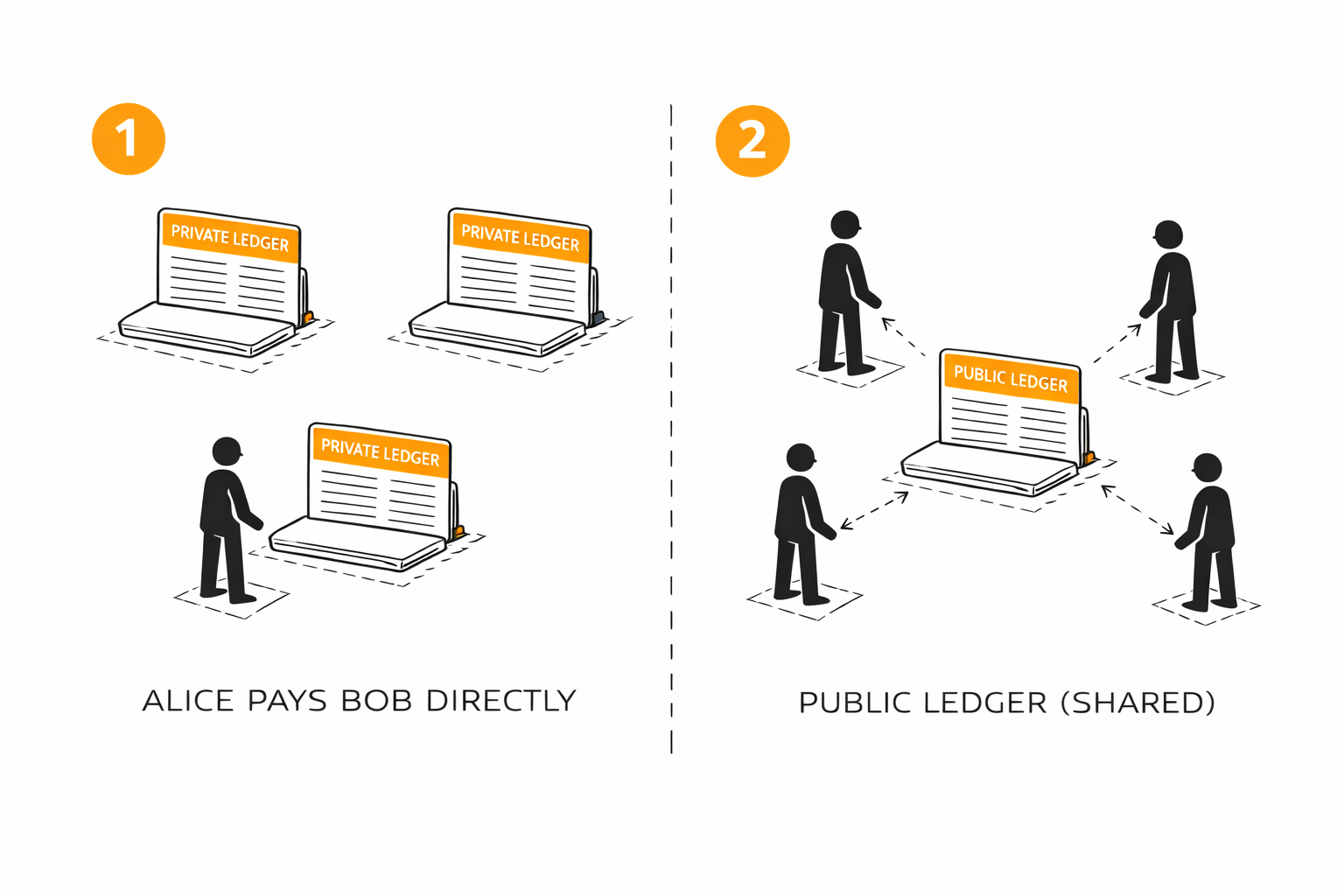
Bitcoin allows a direct payment path instead of routing every payment through a processor.
That does not make Bitcoin magical. It makes it a different kind of payment system—one where the message goes directly from sender to recipient, and the math does the work that a middleman used to do.
The Record Is Shared—And Checkable
Traditional ledgers are private. Your bank has one. A merchant has another. A payment company may keep a third. If those records disagree, the parties have to work it out.
Bitcoin uses a shared ledger instead. Many computers keep copies of the same history. No single machine is the whole system. No single office is “the place” where Bitcoin lives.
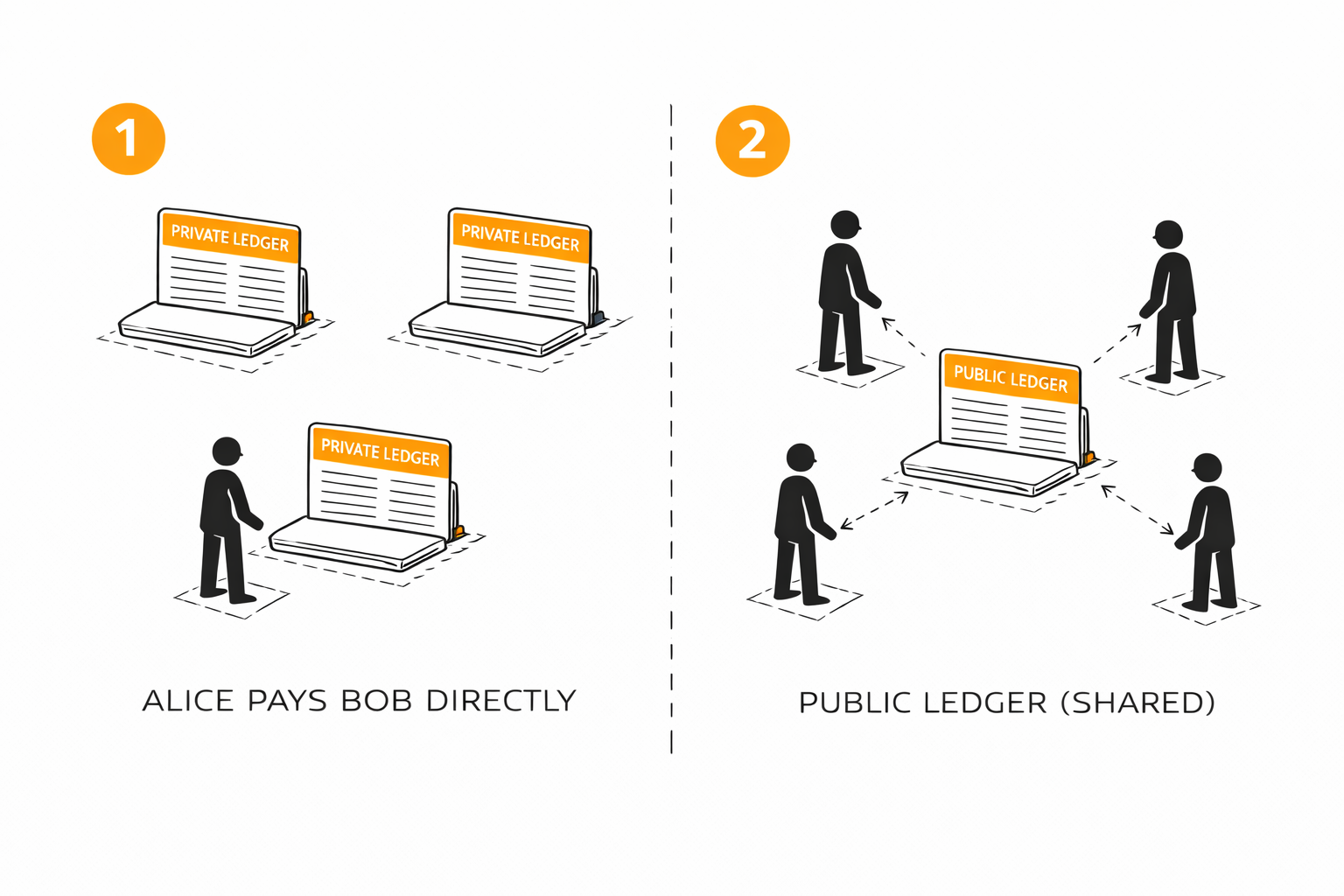
Private ledgers stay separate. A public ledger gives many participants the same record.
This is why people call Bitcoin distributed. Copies of the ledger exist in many places, under many operators, at the same time.
There is something else unusual about this ledger: it is public. When Maya looks up her transaction on a block explorer later, she is seeing something most financial systems do not offer—a record that anyone can verify independently. Not because the system is broken, but because it was designed that way.
Traditional payments are private by default, which means you trust the bank’s version of the record. Bitcoin payments are public by default, which means you can check. That transparency is not an accident. It is a design choice, and it has consequences—some empowering, some worth thinking carefully about—that we will return to later.
Bitcoin is a shared public record, and a wallet gives you keys that let you sign messages authorizing changes to your part of that record.
Try it. Look up a real transaction on the shared record: transactions/verify-on-chain.livemd.
Most users do not need the full history on their phones. A lightweight wallet can still be useful because it talks to the network without carrying the whole chain itself.